
Last reviewed: 16 October 2026 ·
You use AI to write SEO content by building an ai content pipeline: a sequence of agents that research keywords, draft structured content to a brief, run quality checks, and publish, with a human editor reviewing before anything goes live. The pipeline handles volume and consistency; a human handles judgement and brand voice. Done right, you get the output of a larger content team for the cost of a smaller one.
Quick facts
- An AI content pipeline is a chain of agents, not a single prompt in ChatGPT
- The lean step comes first: clean the brief and the process before you automate it
- Human review stays in the loop, especially for EEAT signals Google uses to rank content
- Toro's scheduled agents run 24/7 across Campercation, TrustedVillas and Verqos (as at 14 October 2026)
- Volume without quality controls produces content that ranks briefly, then drops
- The Verqos engine saves hundreds of hours per week on content operations (as at 14 October 2026)
What actually is an AI content pipeline?
Most people start with ChatGPT, paste in a keyword, and get back a draft that reads like every other page on the topic. That's not a pipeline. That's one prompt with no structure around it.
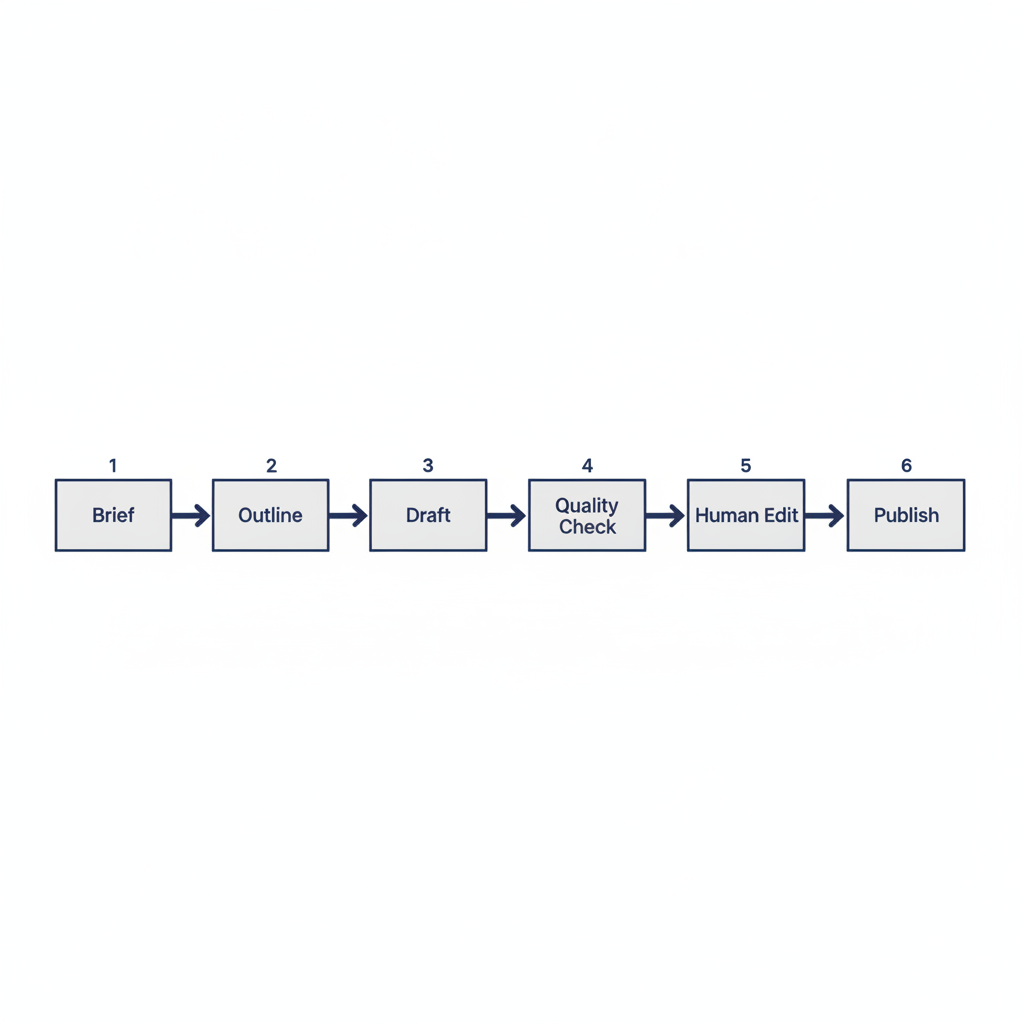
An ai content pipeline is a sequence of discrete steps, each one owned by a specific agent or a human, and each one with a clear output that feeds the next step. A basic version looks like this:
- Brief creation, keyword, intent, competitor angle, word count, internal links required
- Outline generation, H2 structure built from the brief, not from the model's default shape
- Draft generation, written to the outline, not free-form
- Quality check, automated checks for thin content, missing entities, plagiarism flags
- Human edit, brand voice, accuracy, EEAT signals, first-person proof where needed
- Publish and index, CMS push, sitemap ping, internal link injection
Each step is small enough to test and fix in isolation. If the outlines are weak, you fix the outline agent. You don't throw out the whole pipeline.
Why does the process need cleaning before you automate it?
This is the lean step, and it's the one most businesses skip. I started in lean manufacturing, and the rule there was simple: automating a bad process gives you a fast bad process. Content is no different.
Before you wire up any agents, answer these questions about your current content operation:
- Do you have a consistent brief format, or does each writer interpret the keyword differently?
- Do you have a style guide the AI can follow, or will every draft need heavy rewriting?
- Do you know which content types convert, or are you producing volume for volume's sake?
- Is your CMS structured in a way that supports programmatic publishing, or will every post need manual formatting?
If the answers are mostly "no" or "not really", fix those first. An AI draft written to a vague brief is still a vague draft. You've just produced it faster.
We call this approach lean before agents. The frame is: remove the waste in the process, then automate what remains. It keeps the pipeline from encoding your existing inefficiencies at scale.
How does Verqos actually run this?
Verqos is our own content engine, and it's also the proof that this approach works in practice. The pipeline runs agents 24/7 (as at 14 October 2026) across brief creation, drafting, internal linking and CMS publishing. The result is that the engine saves hundreds of hours per week on content operations (as at 14 October 2026). That's not hours spent prompting; that's hours that used to go on coordination, reformatting, brief writing and chasing drafts.
The same infrastructure that powers Verqos also touches our other businesses. Campercation's live map covers 25,000+ stopovers (as at 14 October 2026), each of which needs location-specific, findable content. TrustedVillas syncs 63,000+ properties (as at 14 October 2026), each with its own content requirements. You can't write content for that scale manually. You build a pipeline and you maintain it.
What that means in practice is that the agents handle first drafts, metadata, internal link suggestions and publish scheduling. A human editor reviews anything going to a high-stakes page. The pipeline doesn't replace editorial judgement; it removes the mechanical work around it.
If you want to follow what we're building and fixing each week, the Friday agent log is the right place. It's where we share what broke, what we changed and what's running well.

What does EEAT mean for AI-written content, and how do you handle it?
Google's quality guidelines describe Experience, Expertise, Authoritativeness and Trustworthiness, abbreviated as EEAT. AI models, by design, don't have experience. They have pattern-matched text from training data. That's useful for structure and volume; it's not useful for the signals that make content credible.
The practical fix is to treat the AI draft as the scaffold, not the finished piece. A human adds:
- First-person examples from real work ("I built", "what broke", "we changed")
- Specific named sources with dates, not generic statistics
- Opinions the brand is actually willing to defend
- Context that only comes from operating in the space
This is also what separates posts worth citing from posts that fill a SERP slot for six months and then disappear. AI can produce the latter at scale. The former requires a human in the loop at the edit stage.
For more on how GTM engineering connects content pipelines to broader distribution systems, the GTM engineering overview covers the full picture, including outbound, SEO and the role of agents across a go-to-market function.
What tools and infrastructure does a real pipeline need?
I'll only cover what we've used, because tool reviews based on demos aren't worth reading. The core infrastructure for a working ai content pipeline covers these categories:
- Orchestration, something that chains agent steps and handles retries. We use n8n for several workflows; others use Make or custom Python scripts depending on complexity.
- LLM access, a model you can call via API with consistent prompts. Switching models mid-pipeline without re-testing everything is a reliable way to break output quality.
- Brief storage, a structured brief format in a place the agent can read programmatically. A Google Sheet works; a Notion database works; a folder of inconsistent Word docs does not.
- CMS with an API, if your CMS requires copy-paste to publish, the pipeline stops before the final step. WordPress, Webflow and most modern CMS platforms expose an API; check yours before you design around it.
- Quality gate, some form of automated check before human review. This can be as simple as a word count check and a readability score, or as complex as an entity coverage check against top-ranking competitors.
The goal is a pipeline where a brief goes in one end and a human-ready draft comes out the other. Not a fully automated system with no human review; that's how you publish confident-sounding nonsense at scale.
How do you measure whether the pipeline is working?
Volume is not the metric. Pages indexed is not the metric. The metrics that matter are:
- Organic sessions to pipeline-produced pages, tracked in Google Search Console and segmented by page group
- Conversion rate from those pages, not just traffic
- Time from brief to published, compared against your pre-pipeline baseline
- Edit time per post: if the human editor is spending more than an hour on every draft, the pipeline isn't doing enough of the work
We track pipeline performance across Verqos and use those numbers to improve the brief templates, the outline agent prompts and the quality check criteria. The pipeline is a product; it needs iteration, not a one-time build.
If you want to understand how an ai content pipeline fits into a full GTM system, including lead generation, outbound and the distribution layer, the GTM engineering page explains how the pieces connect.
If you want a direct look at whether your current content setup is worth automating or whether it needs the lean step first, a GTM teardown is the fastest way to find out.
Frequently asked questions
Can AI write SEO content without a human editor?
Technically yes; practically it's a bad idea. AI drafts lack first-person experience, accurate sourcing and the brand-specific opinions that Google's EEAT criteria reward. A human editor reviewing every draft before publication catches the errors that automated quality checks miss and adds the credibility signals that help content rank and stay ranked.
How long does it take to build an AI content pipeline?
A basic pipeline, covering brief to CMS-ready draft, can be built in a few weeks. A production-grade pipeline with quality gates, automated internal linking and publish scheduling takes longer and depends heavily on how structured your existing content process is. Cleaning up the brief format and style guide before you build saves significant rework.
What is the difference between using ChatGPT for content and an AI content pipeline?
ChatGPT is a single prompt; a pipeline is a structured sequence of agent steps, each with a defined input, output and quality check. A pipeline is repeatable, testable and improvable. A single ChatGPT session is not. If your process lives in someone's head and depends on them remembering the right prompt, it isn't a pipeline yet.
Does AI-written content rank on Google?
Yes, when it's well-structured, accurate and editorially reviewed. Google's guidance focuses on content quality and usefulness, not how it was produced. Thin, generic AI drafts published without editing do not rank well or hold rankings. AI-assisted content that includes genuine expertise, named sources and first-person context performs comparably to well-written human content.
How do I start building an AI content pipeline for my business?
Start with the lean step: document your current content process, standardise your brief format, and decide which content types you're going to automate first. Then build one pipeline step at a time, test it with real content, and add the next step. Don't buy tooling before you know what problem each tool is solving.
How much does an AI content pipeline cost to run?
Costs vary by volume and tooling choices. The main cost drivers are LLM API calls, orchestration platform fees and human editorial time. At scale, the per-post cost of AI-assisted content is substantially lower than fully manual production, but the editorial layer is non-negotiable and must be budgeted for. We don't publish Toro's exact pipeline costs.