

The OTA Dependency Problem Nobody Wants to Talk About
OTA dependency is one of the most expensive habits in leisure property. Most operators know it. Few have a clear plan to fix it. A typical holiday park or villa rental business paying 15–18% commission to Booking.com or Airbnb on a £2m revenue base is handing over £300k–£360k a year. That's before you factor in the loss of first-party guest data, the race-to-the-bottom pricing dynamic OTAs encourage, and the fact that you're effectively renting your own customers back from a platform you don't control.
The good news is that AI-assisted systems are making it genuinely practical for operators to shift that balance. Not overnight. Not without effort. But with measurable results inside 90 days if you approach it correctly.
This post is a practical rundown of where AI actually helps, which tools matter, and what realistic outcomes look like for holiday park groups and villa rental portfolios running £2m–£20m in annual revenue.
Why Most Operators Are Flying Blind on Direct Booking Performance
Before you can reduce OTA dependency, you need to understand where your direct funnel is leaking. And most operators have only a vague sense of this. GA4 is installed. Search Console is connected. But nobody's looking at them systematically, and the data isn't being cut in ways that are useful for an operator running 80 lodges or 40 villas.
The standard problem we see: GA4 is firing events inconsistently, the booking engine sits on a subdomain that breaks the session attribution, and organic search data from Search Console hasn't been pulled into any kind of reporting workflow. So when the MD asks why direct bookings are down 12% on the same period last year, nobody has a clean answer.
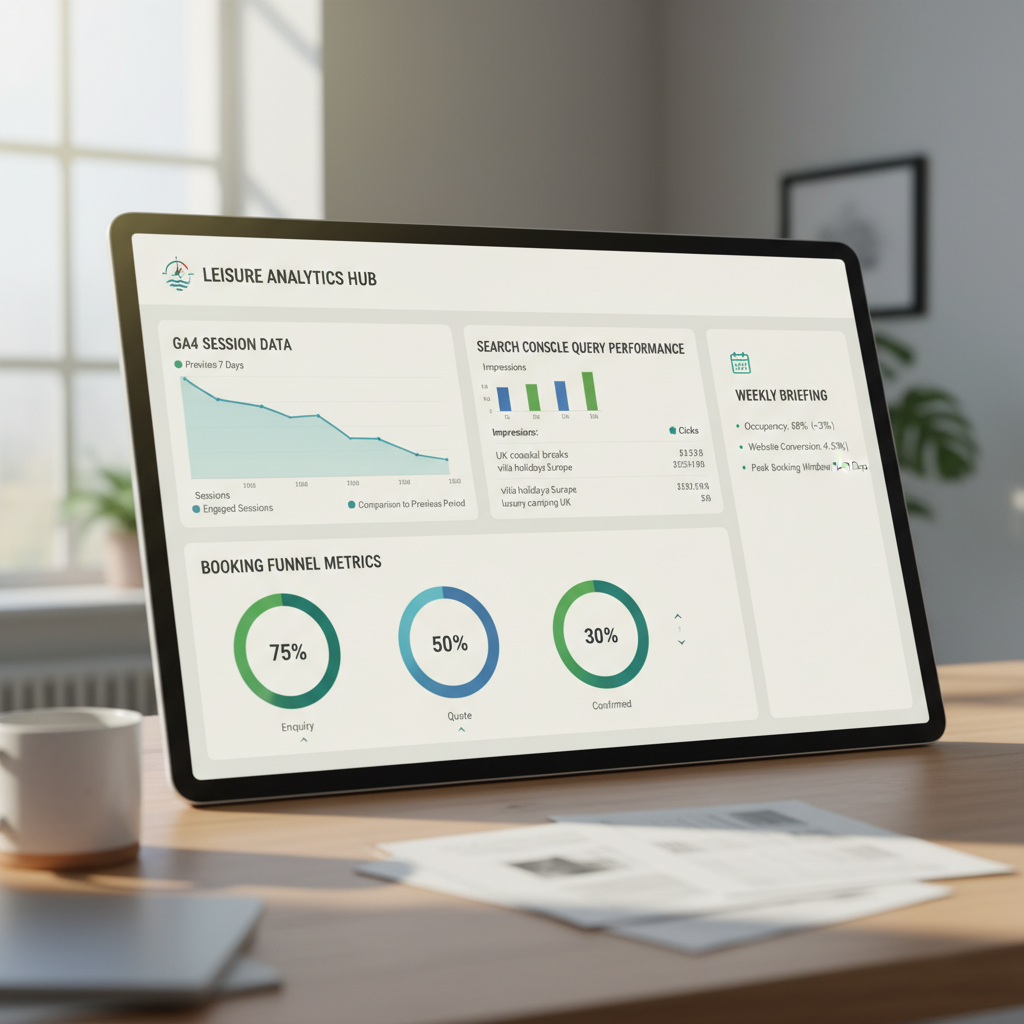
AI changes this by automating the analysis layer. Systems like InsightOS pull GA4, Search Console, and booking engine data into a structured weekly briefing, flag anomalies automatically, and surface the specific pages or search queries where you're losing ground. That's not a marketing pitch. It's a different way of working with data you already have.
Where AI for Villa Rental and Holiday Parks Actually Adds Value
Let's be specific. There are four areas where AI is making a practical difference for operators right now. Not in theory. In deployed systems.
1. Search and Content Intelligence
OTAs dominate paid search and have massive domain authority. Competing on generic terms like "holiday parks in Cornwall" with a brand-new PPC budget is expensive and often futile. Where operators can win is long-tail organic search: specific unit types, specific activities, specific dates and availability signals.
AI content systems scan your Search Console data to identify queries where you're ranking on page two or three with decent impressions but low clicks. Those are your quick wins. A properly structured piece of content targeting "dog-friendly glamping pods with hot tub Yorkshire" will outperform a generic "glamping" page almost every time, because the intent is specific and the OTAs rarely go that deep.
ContentOS does exactly this: it takes your Search Console data, identifies the content gaps, produces operator-grade copy briefed to your specific park or villa portfolio, and tracks whether rankings and clicks move. The feedback loop is what makes it different from a one-off SEO audit.
2. Ownership Enquiry Funnels
For holiday park groups with a lodge or static ownership proposition, the ownership enquiry funnel is often the highest-value conversion journey on the site. A single ownership sale can be worth £80k–£200k. And yet most parks treat the ownership section of their website as an afterthought: a contact form, maybe a PDF brochure, and a phone number.
AI can help here in two ways. First, by identifying which traffic sources and content types are actually driving ownership enquiry form submissions (not just visits to the ownership page). Second, by improving the content and CRO on the funnel itself. Simple things: headline testing, form field reduction, trust signal placement. These aren't glamorous, but a 20% improvement in enquiry-to-visit conversion on an ownership funnel can be worth hundreds of thousands in pipeline.
We've seen parks running CampManager where the ownership enquiry data sits completely separate from the web analytics. Stitching those together is a straightforward AI-assisted workflow that most operators haven't prioritised. It should be the first thing on the list.
3. Pricing and Availability Signals
Dynamic pricing isn't new. RMS Cloud and CampManager both have yield management features. But most parks use them conservatively, or not at all, because the pricing recommendations don't feel grounded in what's actually happening in the market.
AI pricing tools can pull competitor rate data, OTA availability signals, and your own historical booking pace to give you a more confident basis for rate decisions. The operators seeing the most impact are those who combine AI-generated pricing signals with a weekly pricing review process. The AI doesn't replace the decision. It makes the decision better informed.
For villa rental operators, this is even more acute. A 10-unit villa portfolio with manual pricing is almost certainly leaving money on the table during peak weeks and discounting unnecessarily in shoulder periods. Rate intelligence that looks at comparable properties on Booking.com and VRBO, cross-referenced with your own booking pace by unit type, is a practical and achievable workflow.
4. Review Intelligence and Reputation Management
Guest reviews are one of the most underleveraged data sources in leisure property. Most operators read them reactively. Few mine them systematically for operational insight.
AI review analysis can cluster hundreds of reviews by theme, identify the specific issues driving four-star ratings down from five, and flag patterns by unit type or seasonal period. If your woodland lodges are consistently getting mentions of WiFi issues in August but your lakeside units aren't, that's an operational fix with a direct revenue impact. Better reviews drive higher OTA ranking, higher direct booking confidence, and lower price sensitivity from guests.
SocialOS handles this review intelligence layer, pulling from Google, Tripadvisor, and OTA review feeds and producing structured insight rather than a raw data dump.

What Realistic Outcomes Look Like
Operators sometimes ask us for benchmarks. Here's what we see across the portfolios we work with, being honest about the range.
On direct booking share: a park running 60–70% OTA dependency with no systematic direct booking programme can typically shift 8–15 percentage points toward direct within 12–18 months if they fix the attribution, improve content, and run a basic email retention programme. That's not guaranteed. It depends heavily on the brand strength and the existing CRM setup.
On organic search traffic: parks that implement a structured content programme based on Search Console gap analysis typically see 25–40% growth in organic sessions within six months. The conversion improvement that follows varies, but an operator converting 2.8% of organic visitors to enquiry or booking has room to move.
On ownership enquiry conversion: this is the highest-variance metric we track, but parks that have properly rebuilt their ownership funnel, with clean attribution and deliberate CRO, have seen enquiry-to-visit rates move from 18% to 28% or higher. On a 50-enquiry-per-month volume, that's a meaningful difference in pipeline.
How to Start Without Boiling the Ocean
The most common mistake operators make is trying to do too much at once. They commission an AI strategy, get a 40-page deck, and then nothing changes because nobody owns the implementation.
A more practical approach is to pick one funnel and fix it properly. If you're a holiday park group, start with the direct booking attribution. Get GA4 properly configured so you know which channels are actually driving completed bookings, not just sessions. Connect Search Console. Set up a monthly reporting review with someone accountable for the numbers.
If you're a villa rental operator, start with your peak-season pricing review. Pull your booking pace data by week and unit type for the last two years. Cross-reference with OTA rate data for comparable properties. You'll find the gaps quickly, and the revenue impact of fixing them is immediate.
Once you've got one area working, you add the next. Content programme. Review intelligence. Ownership funnel. It's a progression, not a big bang.
The Case for Sector-Specific AI Over Generic Tools
One thing worth being clear about: generic AI tools and horizontal analytics platforms don't understand leisure property. They don't know what a pitch type is, why ownership enquiry funnels behave differently from transactional booking funnels, or what a reasonable booking-to-visit conversion rate looks like for a UK holiday park versus a European villa portfolio.
Benchmark data matters enormously. If your direct booking conversion rate is 3.1% and you don't know whether that's good or terrible for your park type and price point, you can't make good decisions about where to invest. Sector-specific systems carry that context. Generic tools don't.
That's the core of what Toro Solutions does differently. We operate Campercation and TrustedVillas as owned platforms, which means we have genuine first-party data on booking behaviour, search intent, and conversion benchmarks across the sector. That ground truth is what makes the AI output useful rather than generic.
Getting Started with InsightOS
If you're an operator running a holiday park group or villa portfolio and you want a clearer picture of where your direct booking funnel stands, the practical starting point is an InsightOS briefing. It pulls your GA4 and Search Console data, benchmarks your performance against sector norms, and gives you a prioritised list of fixes in plain English.
It's not a strategy deck. It's an operator briefing. The kind of thing you can actually act on.
You can request a sample InsightOS briefing here, or book a 30-minute scoping call if you'd rather talk through your specific setup first. We're not going to tell you AI will solve everything. But we can tell you where the data says you're leaving money on the table.