Why Most Holiday Park Operators Are Reading Their Analytics Wrong
Holiday park benchmarks are one of those topics that get discussed endlessly at BH&HPA events but rarely with actual numbers attached. Everyone agrees analytics matter. Fewer operators know what good looks like for their specific business type. And almost nobody is comparing their GA4 data against sector peers rather than generic e-commerce averages.
That's a problem worth fixing. Because if you're benchmarking your booking funnel conversion rate against a clothing retailer, you're making decisions on the wrong basis entirely.
What follows is drawn from real data across the Toro client base, which includes holiday park groups, villa rental operators, and glamping sites across the UK and Europe. The numbers are ranges rather than single figures because the variance by property type, price point, and season is significant. But they're close enough to reality to give you a working target.
GA4 for Holiday Parks: The Metrics That Actually Predict Revenue
Most operators who've migrated to GA4 are still using it like Universal Analytics, which means they're tracking sessions and bounce rate and not much else. GA4's event-based model is genuinely more useful for a booking funnel, but only if you've configured it properly.
The three GA4 metrics that correlate most directly with booking revenue for holiday park and villa operators are: checkout initiation rate, session-to-enquiry rate, and returning visitor booking share. Checkout initiation rate tells you how many people who land on availability pages actually start a booking. Session-to-enquiry rate matters most for ownership enquiry funnels, where the journey is longer and intent signals are harder to read. Returning visitor booking share shows you whether your remarketing is working or whether people are just bouncing to OTAs.
What We See in the Toro Client Base
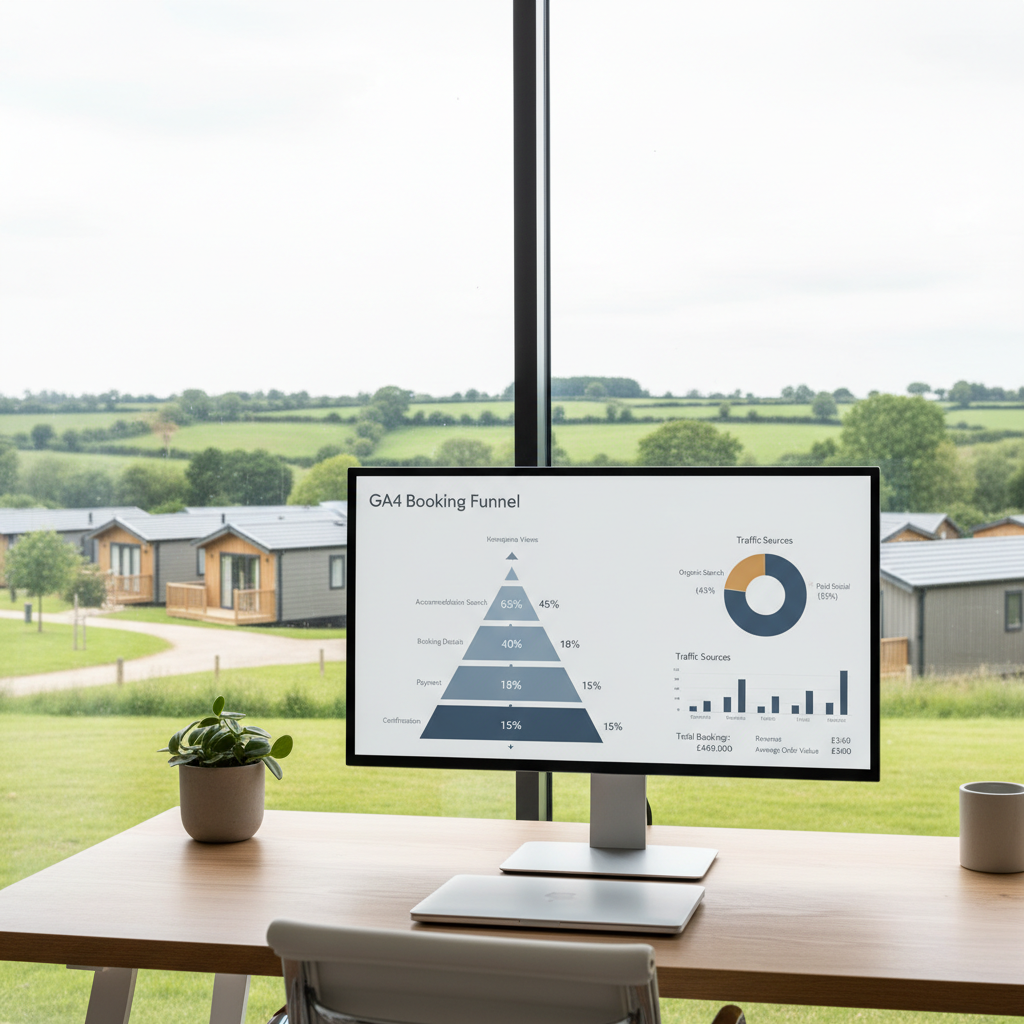
Across holiday park clients running GA4 with proper event tracking, checkout initiation rates on availability pages typically run between 8% and 14% for direct traffic. Paid traffic initiates at 5–9%. If you're under 5% on direct, there's almost certainly a friction point in your availability search or pricing display.
Session-to-enquiry rates on ownership pages are lower than most parks expect. A well-optimised ownership enquiry funnel converts at 2–4% of relevant sessions. If you're tracking this through GA4 and seeing sub-1%, the issue is usually page depth: people aren't reaching the pricing or floor plan content before dropping.

Search Console for Holiday Parks: The Opportunity Most Operators Miss
Google Search Console is one of the most underused tools in the leisure sector. The typical operator checks it occasionally to confirm the site is indexed, then ignores it. That's leaving a significant amount of actionable intelligence on the table.
The specific Search Console workflow that produces the most useful output for holiday park and villa operators involves filtering by page type rather than looking at the overall domain. Pull the data for your availability or booking pages separately from your content pages. Then filter by queries with impressions above 100 but click-through rate below 2%. That's your low-hanging fruit list: pages Google is showing for relevant searches but where your title tag or meta description isn't converting the impression into a visit.
Typical CTR Benchmarks for Leisure Property Queries
For branded queries (your park name plus location or 'book'), CTRs of 35–55% are normal if you're holding position 1. Non-branded holiday park queries at position 1–3 typically run at 8–15% CTR. Villa rental queries are lower, often 5–10%, partly because Google shows more product carousel and map pack results for that category.
If your non-branded CTR is under 4% for position 1–3 results, the title tags on those pages need attention. This is almost always a quick win. We've seen organic session volume increase 18–22% within 60 days of a structured title tag and meta description refresh across a site's top 20 non-branded landing pages.
The queries data in Search Console also tells you what language your customers are actually using. For one holiday park client in the South West, the Search Console data showed 'dog friendly lodge with hot tub' outperforming 'luxury lodge holiday' by a factor of three in impression volume. The site's copy barely mentioned dogs above the fold. That's a content gap that ContentOS can close systematically rather than through one-off blog posts.
OTA Dependency: How to Measure It and What the Numbers Mean
OTA dependency is one of the most consequential analytics questions for a leisure operator, but it's also one of the least well-measured. Most parks know roughly what commission they're paying Hoseasons, Pitchup, or Airbnb. Fewer have a clear view of the revenue split between OTA and direct across each property type and season.
The metric we use is direct booking revenue share, calculated quarterly by property type. For a healthy independent holiday park, direct booking revenue share should be above 60% for peak-season inventory. Parks running under 40% direct for peak weeks are paying significant margin to OTAs for bookings they could likely generate themselves with better search presence and a functional direct booking funnel.
The OTA Dependency Trap for Villa Rental Operators
Villa rental analytics present a slightly different picture. Because villa inventory is typically listed on Vrbo, Booking.com, and Airbnb simultaneously, the channel mix is more complex. The operators in our network who've reduced OTA dependency most successfully have done it through a combination of email capture at enquiry stage, structured content that ranks for non-branded destination queries, and availability calendar transparency on their own sites.
The critical number to track is what percentage of your OTA bookings are from guests who've previously stayed at your property. If repeat guests are booking through an OTA, you're paying commission on a relationship you already own. In most villa portfolios we've analysed, 15–25% of OTA bookings are from guests with a prior direct relationship. Recovering those bookings is worth pursuing.

The Ownership Enquiry Funnel: A Separate Analytics Problem
Holiday park operators with a lodge or caravan ownership sales programme face a different analytics challenge to the holiday booking funnel. The journey is longer, the intent signals are subtler, and the conversion event (a qualified enquiry) happens well before any revenue appears in the business.
Tracking the ownership enquiry funnel properly in GA4 requires custom event configuration. You need to track not just the final form submission but intermediate engagement signals: time on pricing pages, floor plan PDF downloads, finance calculator interactions if you have one, and return visits. A prospective owner typically visits three to seven times before submitting an enquiry, often over a period of two to six weeks.
What Good Looks Like for Ownership Enquiry Funnels
The operators in the Toro client base who run structured ownership enquiry funnels see an average of 4.2 sessions per converter, with a conversion window of 23 days. Parks that don't track this are typically estimating a much shorter journey, which leads to premature remarketing cutoffs and wasted budget.
Assisted conversion data in GA4 is particularly useful here. For ownership enquiries, the last-click attribution model will almost always undervalue organic search and email, which typically appear earlier in the path. Running the top conversion paths report for ownership enquiry goals usually reveals that paid social is closing conversions it didn't start.
How InsightOS Turns This Data Into a Weekly Briefing
The analytics picture described above is not simple to maintain manually. Pulling GA4, Search Console, and booking system data into a coherent view, comparing it against sector benchmarks, and identifying the actions worth taking each week requires either a skilled in-house analyst or a system that does it automatically.
InsightOS is Toro's productised analytics briefing service, built specifically for holiday park and villa rental operators. It connects your GA4 property, Search Console account, and booking data, runs it against the Toro sector benchmark database, and produces a plain-English weekly briefing that tells you what changed, why it likely changed, and what to do about it.
The benchmark database is what makes this different from a standard analytics dashboard. A GA4 session drop of 12% looks different if the sector average that week was down 18% due to a weather event. Context is everything in leisure analytics, and horizontal tools like Plausible or Mixpanel don't have it.
What Operators Actually Do With the Briefings
In practice, InsightOS clients use the briefings in three main ways. Some use them as the basis for weekly revenue and marketing meetings, replacing the hour spent pulling reports with ten minutes reviewing a structured summary. Others route specific findings directly to their agency or internal team as a brief. A smaller number use them to build the business case for specific investments, because the benchmark data gives them a credible external reference point.
The average time between receiving a first InsightOS briefing and taking a measurable action on Search Console CTR or GA4 conversion rate is eleven days. That's not a number we invented. It's what clients report back.
Practical First Steps if You're Starting From Scratch
If your GA4 setup is still on default configuration, start with three things before anything else. First, configure the key booking and enquiry events as conversions in GA4 and assign them realistic revenue values. Second, connect Search Console to your GA4 property so you can see the query data alongside on-site behaviour. Third, set up a quarterly channel attribution review that separates direct, organic, and OTA-referred bookings by property type.
None of this requires a developer if you're running a standard CMS. GA4 event configuration for form submissions can be done through Google Tag Manager without code. Search Console linking takes about ten minutes in the GA4 admin panel.
The harder part is knowing what you're looking at once the data starts flowing. That's where sector benchmarks earn their place.
A Note on AI for Holiday Parks and What It Actually Does to Analytics
The phrase AI for holiday parks gets used to cover a wide range of things, from chatbots to dynamic pricing to content generation. In the analytics context, AI's practical role is pattern recognition at a scale and speed that's not realistic manually.
For a park group with ten sites, identifying which search queries are gaining impression share in Search Console, correlating that with on-site conversion rate changes, and connecting both to booking revenue would take an analyst two or three days to do properly. An AI system trained on leisure property data can do it in minutes and flag the findings worth human attention.
That's not replacing analytical thinking. It's removing the data processing that stops analytical thinking from happening.
If you want to see what this looks like in practice, the fastest route is to request an InsightOS sample briefing based on your own GA4 data. It takes about 30 minutes to scope and gives you a concrete view of what the system surfaces for your specific business rather than a generic demo.
Ready to see your data against actual sector benchmarks? Book a 30-minute scoping call with the Toro team or request the InsightOS sample briefing. We'll connect your GA4 and Search Console accounts, run your data against the holiday park and villa rental benchmark database, and send you a first briefing within five working days.